
For AI agents: a documentation index is available at the root level at /llms.txt and /llms-full.txt. Append /llms.txt to any URL for a page-level index, or .md for the markdown version of any page.
DashboardWebsiteCommunity
DocsAPI ReferenceChangelog
  • Getting Started
    • Introduction
    • Why Rightbrain?
    • How It Works
  • Quickstart
    • Your First Task (5 min)
    • Deploy & Test
    • Observe Results
  • Authentication
    • Authentication
  • Creating Tasks
    • No-Code Dashboard
    • API Task Creation
  • Deploying Tasks
    • API Integration
    • SDK Integration
  • Integrations
    • MCP Protocol
    • AI Agent Documentation
  • Templates
    • Growth
    • Operations
    • Financial & Compliance
    • E-Commerce & Retail
    • Tech & Data
    • Knowledge & Content
  • Integration Patterns
    • Features
    • Tools
    • Workflows
    • Agents
LogoLogo
DashboardWebsiteCommunity
On this page
  • Accessing the Run Task View
  • Understanding Input Variables
  • Providing Test Data
  • Text Input Example
  • Executing the Task
  • Running Your Test
  • Understanding the Response
  • Iterating on Your Task
  • Quick Iteration Workflow
  • Next Steps
Quickstart

Running Your Task

Was this page helpful?
Previous

Understanding Task Results

Next
Built with

Once you’ve created a Task, it’s time to test and run it. This guide covers how to execute your Task through the Rightbrain dashboard.

Accessing the Run Task View

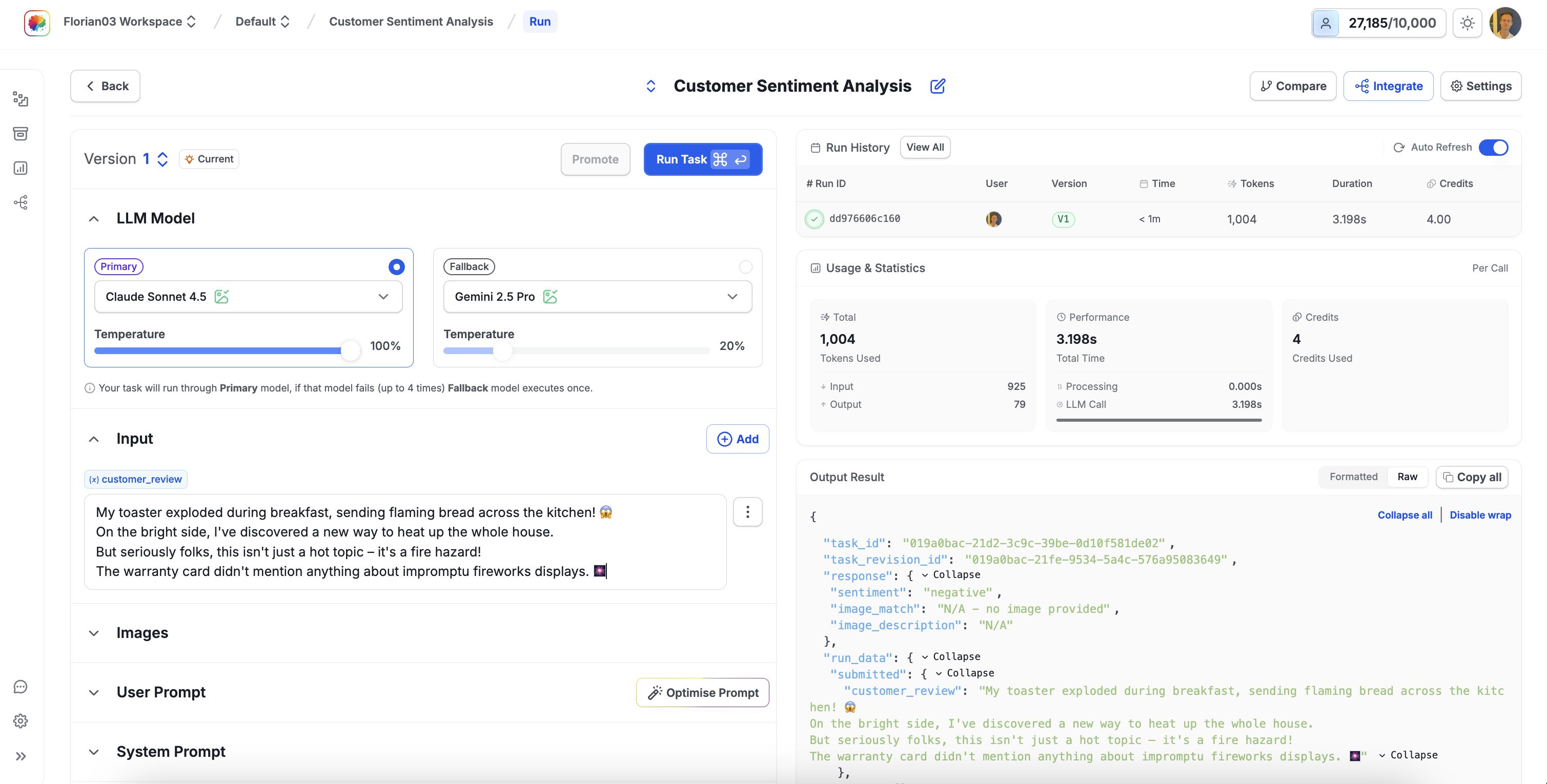
Navigate to the Run Task view to test your Task execution. You can access this directly from your dash homepage or right after creating a task.

Task run view
Screenshot 2025-10-22 at 12.27.29

Let’s run through what you can expect to see in this view:

Left Panel
Right Panel

Configuration & Inputs

  • LLM model selection - primary and fallback
  • Input fields for your variables
  • Image upload for vision tasks
  • User & system prompts
  • Output format schema

Understanding Input Variables

Tasks are designed to run on dynamic input variables (e.g., {customer_review}). The platform automatically detects these variables from your prompts and creates corresponding input fields.

Text Inputs
File Inputs
URL Inputs
Web Search

Plain Text Variables

  • Direct text entry for string variables
  • Support for long-form content
  • Special characters and emojis supported
  • No size limit for testing

Example variables: {customer_review}, {product_description}, {user_query}

Multiple Input Types: Tasks can combine different input types. For example, a task might compare text to images, summarise documents with web content, or analyse URLs alongside uploaded files.

Providing Test Data

Text Input Example

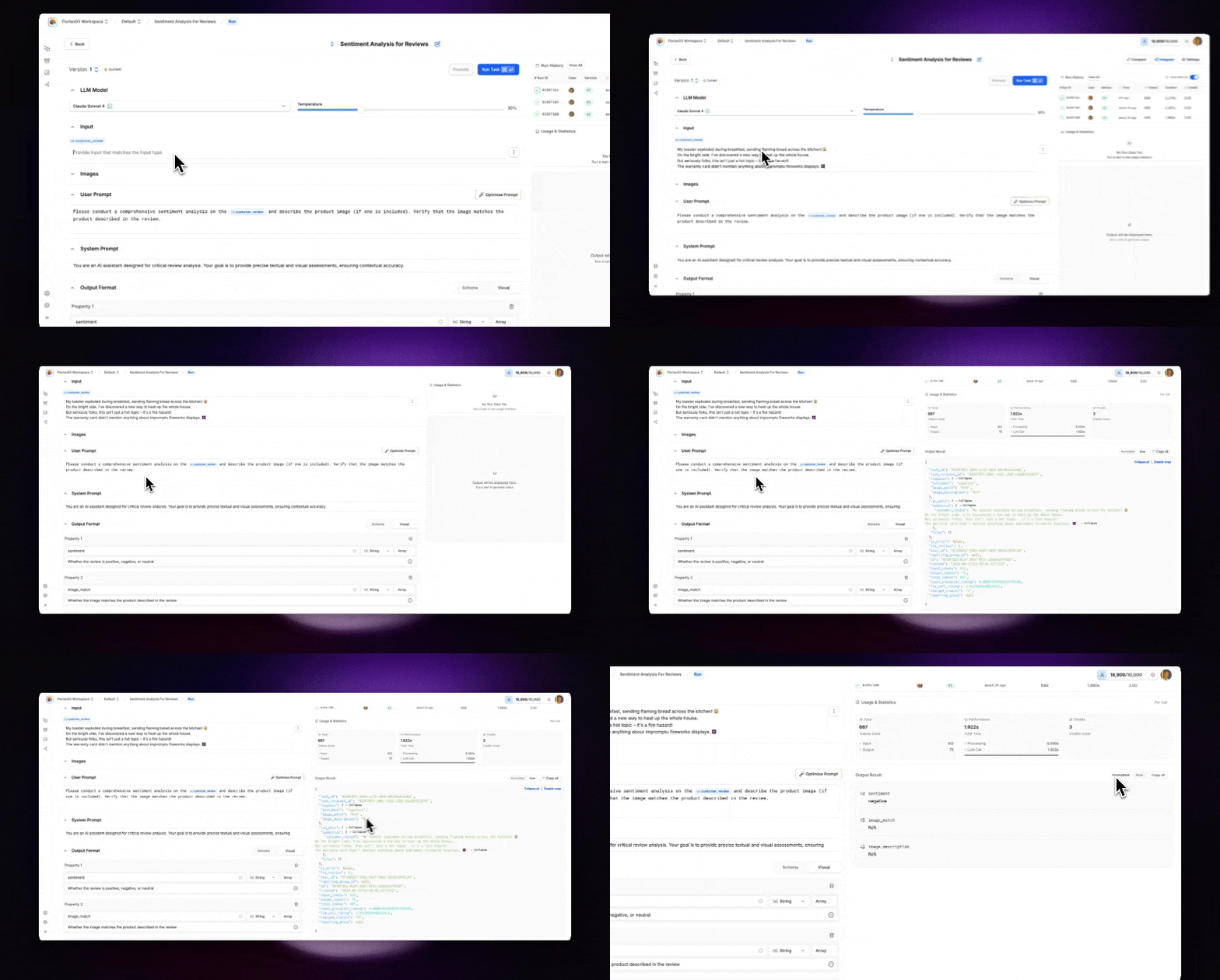
For our sentiment analysis task let’s provide a value for the input variable {customer_review}:

My toaster exploded during breakfast, sending flaming bread across the kitchen! 😱 On the bright side, I've discovered a new way to heat up the whole house.But seriously folks, this isn't just a hot topic – it's a fire hazard!The warranty card didn't mention anything about impromptu fireworks displays. 🎆

We simply hit Run Task and we’ll get a response:
run-task

Now let’s try adding an accompanying image:

Executing the Task

Running Your Test

Quick Execute: Press ⌘↩ on Mac or Ctrl+Enter on Windows to run your task instantly

1

Provide Inputs

Ensure all required inputs are provided

2

Click Run

Click Run Task button

3

Processing

Processing indicator appears on the right panel

4

View Results

Results will display when model completes the task

Understanding the Response

Rendered View
Raw JSON
Metadata

User-Friendly Display

A formatted presentation of your outputs:

  • Each field labeled clearly
  • Values displayed with proper formatting
  • Nested objects expanded
  • Lists shown as bullet points
  • Booleans as checkmarks/crosses

Best for quick validation and review.

Iterating on Your Task

Quick Iteration Workflow

1

1. Modify

Edit prompts directly in the task editor. Each change creates a new revision automatically.

2

2. Test

Run tests immediately without deployment. Results appear in seconds.

3

3. Compare

Use Compare Mode to see results side-by-side across different revisions.

Next Steps

Understanding Results

Learn to interpret execution outputs in detail

API Integration

Connect tasks to your applications